

Puncture and penetration testing for texture analysis and materials testing
 2 minute read


What is a puncture/penetration test?
In a penetration/puncture test a probe is made to penetrate into the test sample and the force necessary to achieve a certain penetration depth or the depth of penetration in a specified time, under defined conditions, is measured and used as an index of e.g. hardness, firmness, toughness.
Both test principles cause an irreversible change in the sample and assume that the sample being investigated is of larger area than the contact area of the probe in use; a sample smaller than the probe contact area would assume compression principles.
The higher the force reading (or the smaller the penetration depth – if measuring in constant force), the more resistant is the material.
The probe used has a smaller diameter than the surface of the sample usually employs cylinders (2mm-10mm in diameter), cones, ball probes or needles.
Spherical probes are recommended where the surface of the sample is not flat or the sample is extremely thin.
 1” Ø Spherical Probe performing Avery Adhesion test
 1” Ø Plastic Spherical Probe testing salmon
Small puncture probes are recommended for assessment of rupture force.
 Puncture test of a capsule using a 2mm Ø Cylinder Probe.
Puncture/penetration is a suitable test for those products that are not-self supporting or are contained.


Penetration may sometimes be the only possible means of testing a hard product if the force capacity is limited.
 2mm Ø Needle Probe performing penetration test on soap
 2mm Ø Cylinder Probe performing penetration test on tablet
Small puncture/penetration probes are recommended for the testing of multiple structure products e.g. measuring skin/crust/coatings and continuing to test the underlying material.


Hemispherical probes are recommended for imitating a finger when assessing actuation force.


Using multiple penetration probes within a test is recommended for products with variable structure either due to nature (fruits, vegetables, meat) or design (marmalade, petfood, confectionery).



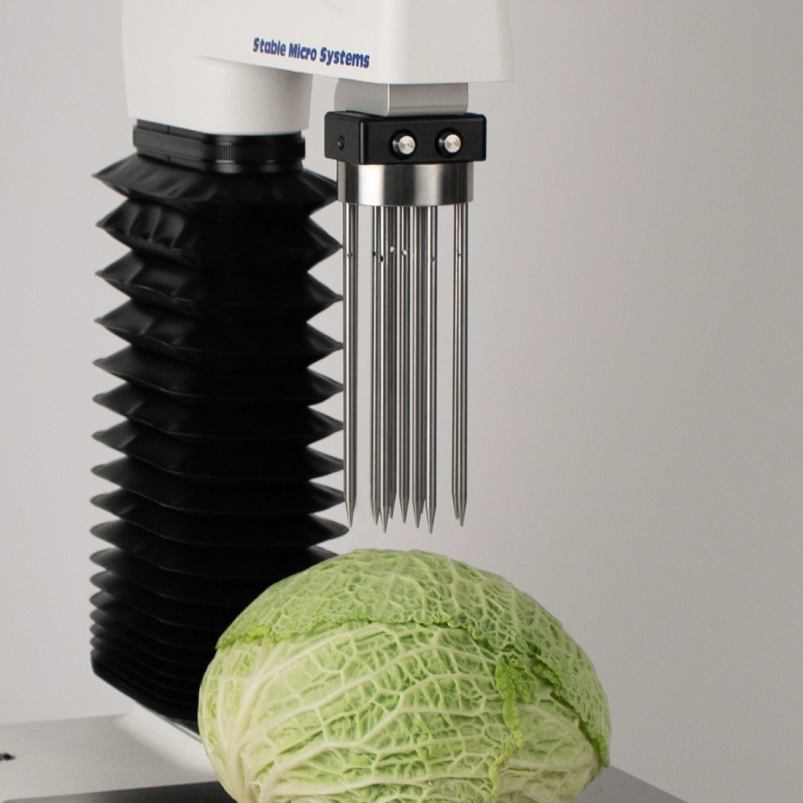
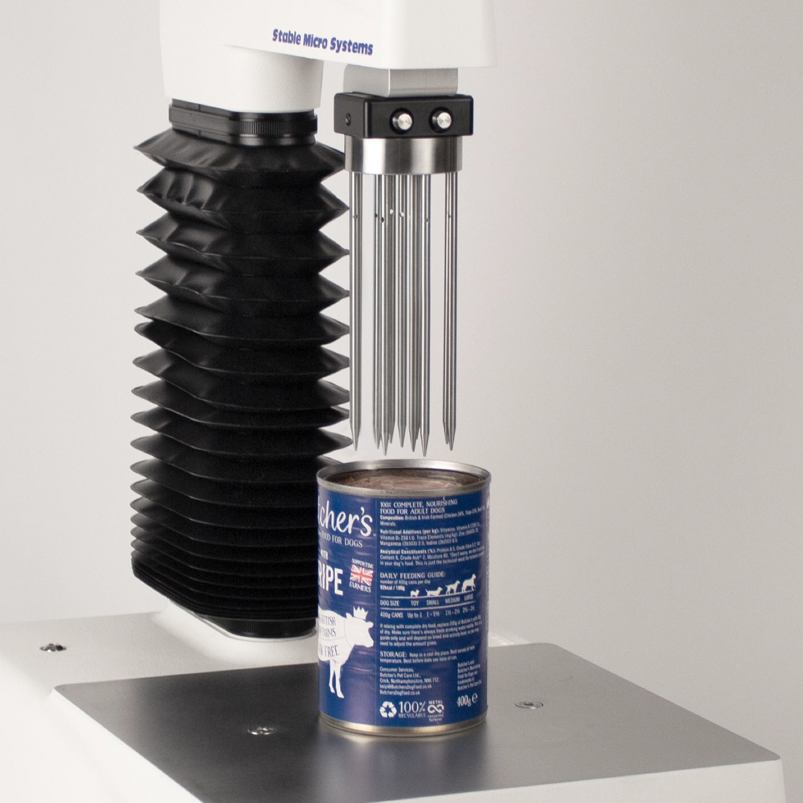
What happens during a puncture/penetration test?
Examples of puncture/penetration testing
To see how to perform puncture and penetration tests using a TA.XTplusC Texture Analyser to measure firmness, gel strength, dipping consistency, product toughness, fracture force, 'cake' breaking strength, semi-solid consistency etc., watch this video and see typical puncture and penetration tests in action:
Topics:
General


