

New Hair Stiffness Rig
The Hair Stiffness Rig gives haircare brands a quick, objective way to measure bending force – and substantiate the hold claims consumers actually believe in.

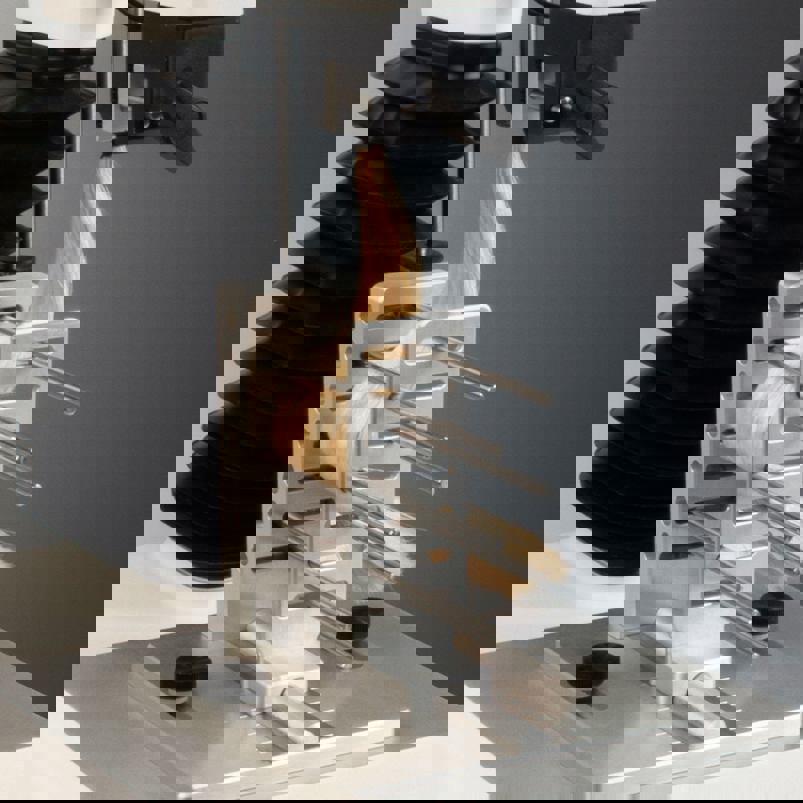
The new Hair Stiffness Rig is yet another quantitative method that will be of use to the haircare industry. It is already well documented that the bending force of a hair bundle can be used as an indicator of softness/stiffness. Using this new rig, a hair bundle can be clamped at one end and the remaining length placed on two supports. The Texture Analyser probe then descends vertically on the sample a set number of times, applying pressure to the central section of the hair bundle and measuring the bending force – a higher bending force indicating a stiffer sample. The new test will enable manufacturers to carry out quick, objective and repeatable evaluation of hair softness/stiffness, optimising their products’ performance and substantiating persuasive beauty claims.
Instinctively, there is a tendency to equate the word stiffness with style longevity but while consumers of hair styling products profess the desire for products that do not adversely affect the feel properties of hair, this stiffness appears to act as the cue that the products are working. There is a widespread use of the word ‘hold’ in advertising and on styling product packaging. However whilst there is a desire for optimal hold it should ideally be without sensorial negatives, i.e. a stiff and or ‘crunchy’, unnatural feel to the hair – a condition lightheartedly referred to as ‘helmet head’. There is an apparent trade-off whereby high hold is generally attained at the expense of poor feel, whilst sensorial improvements often result in a diminished perception of hold which is often equated with style longevity. In short, while consumers profess the desire for a product that creates a style that feels flexible, stiffness appears to provide the reason for consumers to believe in its performance.
The presence of styling polymer deposits promote increased stiffness in the hair sample, which registers in terms of higher deformation forces. A further variation of the method may involve cycling the applied deformation to determine the resiliency of the crust; i.e., earlier deformations may break a portion of the crust and lead to lower forces on subsequent cycles. To prove the holding power of fixatives such as hair spray, the drop in bending force is calculated from the first to last cycle, as the polymer holding cast is broken after the first deformation. A hair tress can be sprayed a chosen number of times or commonly is dipped into a hairspray solution and allowed to dry in a flat position. After drying, the bending stiffness is measured. It must also be considered that the properties of polymer films deposited by styling products are not constant, and performance criteria can change dramatically as a result of formulation and environmental factors i.e. stiffness created by deposited polymers can change dramatically with relative humidity.
The effect of various other hair treatments on softness can also be determined by measuring the tress’s bending properties before and after treatment. For a treatment such as bleaching, an average bending force from a cycle of ten three-point bend tests is calculated for each sample. This is also applicable to measuring the efficacy of conditioner formulations containing new softening ingredients.
Research using this hair characterisation technique at Croda has highlighted how this analytical technology can help the industry substantiate ambitious marketing claims about shampoos and conditioners that claim to leave hair soft and manageable.
In the study, carried out by Croda, the TA.XTplusC Texture Analyser was used to determine the bending modulus of different types of hair, comparing results before and after the application of various hair treatments. For the test, the hair samples were divided into two bundles – one to undergo treatments, the second to be used as a control. Croda’s research revealed that oxidation following hair bleaching, as well as heightened environmental moisture levels, have a significant effect on measurable bending force, an indication of hair softness, in particular where damaged hair is concerned. It also demonstrated the efficacy of conditioner formulations containing new softening ingredients.
Recently a patent released by L’Oreal explains the use of this test approach to perform three-point bend tests using their TA.XTplusC Texture Analyser. This patent describes compositions containing at least two latex polymers and their effect on hair stiffness, wherein at least one latex polymer is a film-forming polymer.
At Stable Micro Systems we have also recently launched the Hair Suppleness Rig and made customers aware of the use of the Volscan Profiler for the measurement of hair properties such as frizziness, curl retention and crown dimensions for tresses and whole head mannequins. Other tests of interest in this field may also be the measurement of cast fixative film flexibility/hardness and its stickiness.




From left: Hair Suppleness Rig, hair sample in the Volscan Profiler and a typical 3D scan produced in Volscan Profiler software.


