

New egg testing solutions

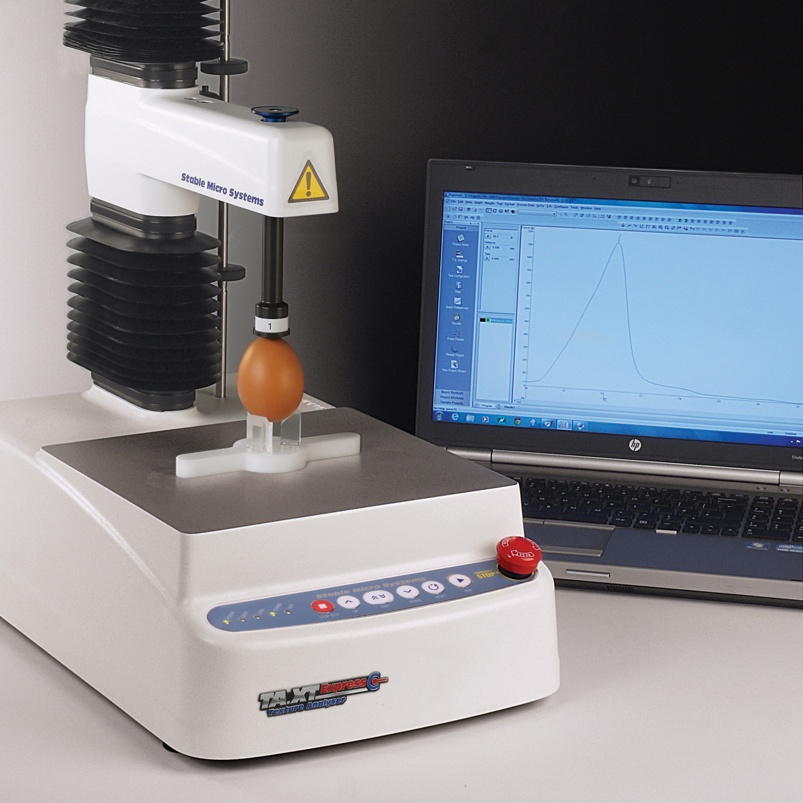
Determining the size, shape, and density of an avian egg has always presented a problem. The measurements require an individual’s visual perception to determine the data points. The smooth surface and ovoid shape of the shell makes using micrometers to determine shape index difficult. Placement of micrometers varies by each individual. Historically, determining the specific density of an egg has required the egg be placed in saline solutions of known concentrations to assess at which concentration the egg ‘floats’. Again, this measurement required the visual perception of when an egg is ‘floating’. Objective determination of egg shape, volume, and density can now be found less than 100 seconds per egg using the Volscan Profiler thanks to a new found solution to the way eggs can be supported vertically in the instrument. The new support solutions that do not require the egg to be pierced (as is the usual manner of supporting samples), hold the egg in place to allow it to be rotated and scanned accurately with a laser to recreate a 3D representation of the sample without compromise to accuracy. Egg shape measurements such as volume, egg length, egg maximum width, shape factor and percent length at maximum width, can then be obtained within the Volscan Profiler software and retained for comparison with future sample scans.

Samples are held in place by the support of a weighted shaft and the addition of user-replaceable mini glue dots. A choice of support solutions (caps) are included in the kit depending upon the sample to be supported. The chosen cap is mounted on the end of the shaft which has a 50g weight fixed to the shaft. An additional 50g and 3 x 50g weights are provided as options depending upon the support required.
In order to mount eggs with perfect vertical alignment, we have also developed a device that holds eggs of varying size (from quail to goose) and presents the sample to the supports. This is necessary if accuracy of shape and dimension measurement is important as a sample that is misaligned will result in compromised results.


Researchers from Purdue University have already investigated the assessment of the shape of the avian egg: Assessing the shape of the avian egg. Their measurements include egg length, maximum width, shape index and length at maximum width. They found that repeated measurement of the same egg produces less than 1% variability in measured outcomes. They reported that egg shape and volume information from the Volscan Profiler can be utilised by poultry breeders, producers, and processors, as well as, housing and processing equipment and egg carton manufacturers.
The USDA have also already highlighted the importance of such measurements in:
They conducted a full profile of physical quality measurements using their VolScan Profiler to determine volume of shell, total length, maximum width, and percent length at maximum width to more accurately indicate egg shape than shape index.
Similarly, researchers from University of Kentucky have already been using their Volscan Profiler for such measurements in: Evaluation of Current and Emerging Techniques for Measuring Eggshell Integrity of the Domestic Fowl
The new support solutions will only serve to make the measurement of egg shape parameters easier to perform with more secure location of samples.
According to the USDA regulation, eggs can be divided into three Shape Index (SI) categories. The shape index is proportional to width and inversely proportional to length, based on this shape index the rate at which eggs grow longer is faster than the rate at which they grow shorter as they grow older. SI<72 and SI 72-76 shape index eggs were found to be more spherical than the SI>76 and the unit mass of the eggs differed significantly when they were categorised. Hen's eggs with a shape index of less than 72% were shown to be heavier than those with a higher shape index.
The physical properties of the egg play a significant influence in the design of appropriate equipment for eggshell hatching, usage, transportation, processing, and storage. The natural variety in egg form could be used as a criterion for designing food processing equipment for cracking and separating egg components. Shape index, geometric mean diameter, sphericity, roundness, surface area, volume, weight, thickness, density, and force are the key physical properties of the egg. Hardness, brittleness, adhesiveness, tensile strength, compression force, and other properties of materials were also measured with their texture analyser.
Other research where egg compression has been performed:
Effect of 25-Hydroxycholecalciferol with Different Vitamin D3 Levels in the Hens Diet in the Rearing Period on Growth Performance, Bone Quality, Egg Production, and Eggshell Quality – by researchers from Sichuan Agricultural University (PDF download)
Impact of egg handling and conditions during extended storage on egg quality – by scientists from the US National Poultry Research Center
Survey of egg quality in commercially available table eggs – by researchers from California State University
The solutions for holding eggs have also been found to be the perfect for other samples such as rocks and spark plugs where it is again not possible to insert pins into the sample in order to support it.


Find out more about these and other solutions for the Volscan Profiler.
Learn how to measure 14 egg quality parameters in 4 minutes using a Texture Analyser


