

Powder flow instrument comparison
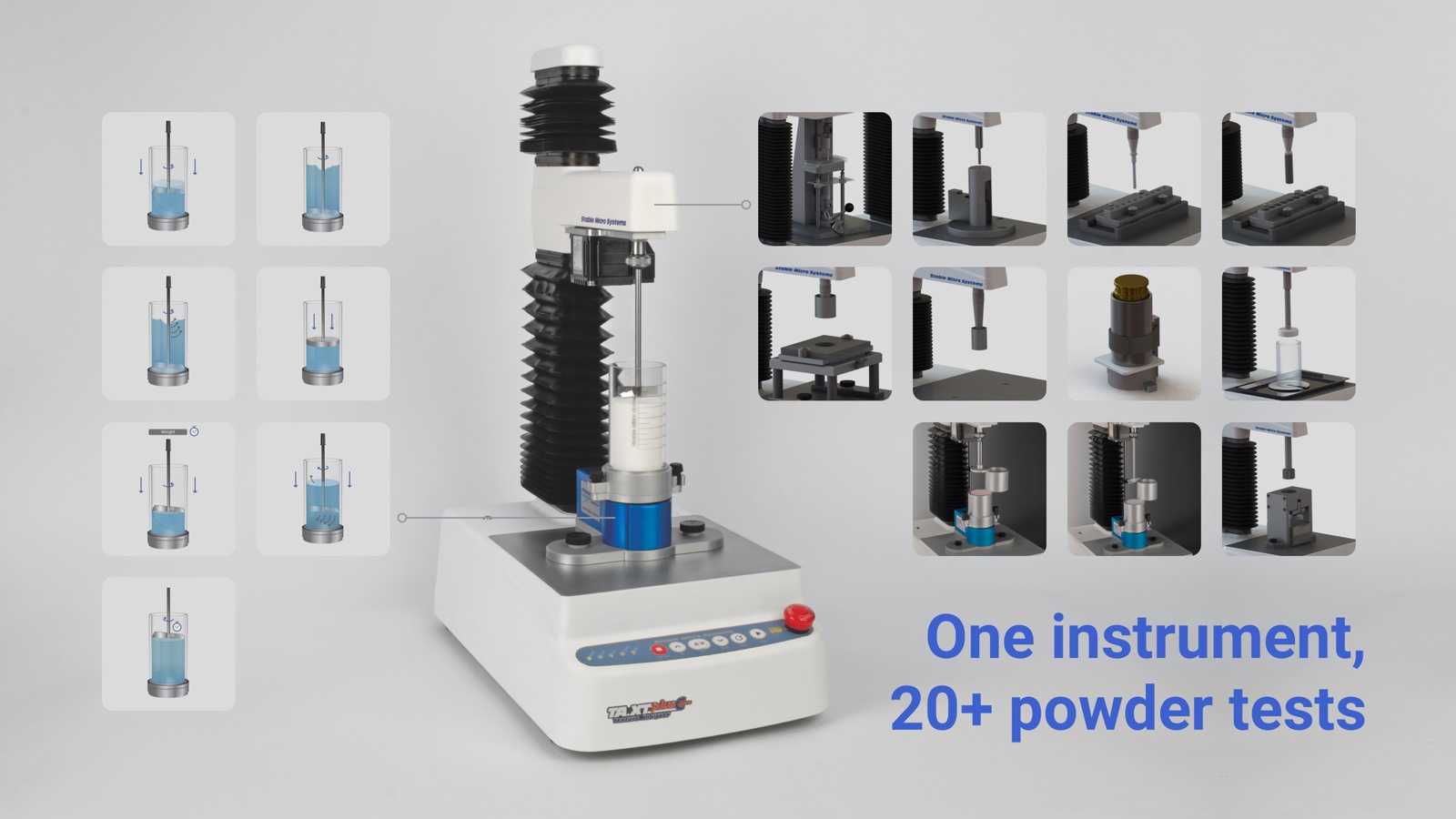
Powder flow behaviour is complex, and no single instrument answers every question. Different methods are designed to probe different aspects of behaviour – from static yield strength and hopper design, to dynamic flow sensitivity, speed dependence, and handling stability.
This page explains what each technique is best suited for and, just as importantly, where each one reaches its limits. The goal is to help you match your testing needs to the right approach – whether that means the Powder Flow Analyser (PFA) + Texture Analyser (TA), another instrument, or a combination of both.
One platform. Complete powder understanding.
The PFA + TA is the only integrated platform that combines dynamic powder flow characterisation with mechanical strength and product testing. This means you can link powder flow behaviour directly to finished product quality – something no standalone powder flow instrument can do.
Quick comparison – what each instrument covers
How to read this table
✔✔ = Directly measured/strong capability
✔ = Available/good capabiltiy
◐ = Partial indirect capability
✖ = Not designed for this purpose
|
Capability |
PFA + Texture Analyser |
FT4 Powder |
Ring Shear |
Brookfield |
Traditional |
|
Dynamic flow behaviour |
✔✔ |
✔ |
✖ |
◐ |
✖ |
|
Speed-dependent testing |
✔✔ |
✔ |
✖ |
✖ |
✖ |
|
Flow stability (handling sensitivity) |
✔✔ |
✔ |
✖ |
✖ |
✖ |
|
Consolidation and caking |
✔✔ |
◐ |
✔ |
✔ |
✖ |
|
Restart/start-stop sensitivity |
✔✔ |
◐ |
✔ |
✔ |
✖ |
|
Powder bed strength |
✔✔ |
✖ |
✔ |
✔ |
✖ |
|
Cake break strength |
✔✔ |
✖ |
✖ |
✖ |
✖ |
|
Tablet/compact strength |
✔✔ |
✖ |
✖ |
✖ |
✖ |
|
Agglomerate hardness |
✔✔ |
✖ |
✖ |
✖ |
✖ |
|
Cake break strength |
✔✔ |
✖ |
✖ |
✖ |
✖ |
|
Flow-to-product correlation |
✔✔ |
✖ |
✖ |
✖ |
✖ |
|
Number of distinct tests |
20–30+ |
~6–8 |
~3–4 |
~3 |
1–2 |
Most powder flow instruments are designed for a single behaviour type. The PFA + Texture Analyser platform covers dynamic flow, storage stability, mechanical strength, and finished product testing in one integrated workflow – without the need to purchase separate instruments for each.
What each instrument is designed for
Powder Flow Analyser + Texture Analyser
The PFA uses a rotating blade moving through a split powder vessel, measuring resistance during both the downward compaction and upward lifting phases. This separates structural resistance from cohesive bonding – something most other instruments cannot do. Tests cover dynamic flow, speed sensitivity, consolidation, caking, and compressibility.
The Texture Analyser applies controlled force through a compression platen, penetration probe, or custom attachment. The same Exponent Connect software handles both instruments, enabling automatic correlation between flow behaviour and product outcomes.
Best for: Troubleshooting production problems, supplier qualification, speed-sensitive processes, storage and restart issues, and any application where powder behaviour needs to be linked to finished product quality.
FT4 Powder Rheometer

A rotational impeller moves through a cylindrical powder vessel in controlled helical patterns, measuring torque and vertical force. Multiple established protocols cover basic flow energy, compressibility, permeability, and stability.
Best for: Dynamic flow characterisation, aeration studies, research-oriented pharmaceutical development, and laboratories where FT4 methods are already embedded in regulatory submissions.
Reaches its limits when: you need to test finished product strength (tablets, compacts, agglomerates), quantify cake break energy after storage, or directly compare behaviour at defined linear speeds matching process conditions.
Ring Shear Tester (Jenike / Schulze type)
Powder in a ring-shaped cell is sheared at multiple normal loads to produce a yield locus. This provides the unconfined yield strength and flow function data required for formal Jenike hopper design calculations.
Best for: Formal silo and hopper design to Jenike or Eurocode standards, wall friction analysis, and fundamental characterisation of static failure behaviour at defined consolidation stresses.
Reaches its limits when: you need to understand dynamic flow behaviour, speed effects, handling drift, or why a mathematically correct hopper design still fails in practice.
Brookfield PFT
Powder is compressed in a cylindrical cell and the unconfined yield strength is measured after the consolidation load is removed. Tests at multiple consolidation stresses generate a flow function and basic caking assessment.
Best for: Basic flowability screening where a simple pass/fail classification is sufficient and budget is limited.
Reaches its limits when: you need speed-dependent behaviour, flow stability, bridging mechanism diagnosis, product strength, or any of the 20+ parameters available from the PFA + TA platform.
Traditional methods (Angle of Repose, Carr Index, Hausner Ratio)
Simple single-number classifications of powder flowability based on geometry (angle of repose) or volume change under tapping (Carr Index).
Best for: Regulatory compendial requirements where USP <1174> or Ph. Eur. specifically mandates these methods for lot release.
Reaches its limits when: you need to troubleshoot production problems. Two powders with identical Carr Index of 18 can behave completely differently in production – one flowing perfectly, one bridging every morning after an overnight shutdown. Traditional tests cannot distinguish them; PFA testing can.
A practical example: the Monday morning problem
Powder flows perfectly on Friday afternoon. Monday morning, it won't discharge.
This is one of the most common and disruptive powder handling problems - and one of the clearest demonstrations of where different instruments give different levels of insight:
Powder Flow Analyser + Texture Analyser: The Caking test simulates weekend consolidation under defined load and time. The Cake Strength and Cake Height Ratio outputs quantify how much of the bed has set and how hard it is to break. Powder Consolidation & Caking directly measures the work required to restart flow after a defined dwell period. The result is not just 'consolidation increased' but exactly how much force is needed and whether the problem is storage-driven or geometry-driven.
FT4: Stability testing shows that flow energy increases after a rest period - confirming the problem exists. Does not quantify restart difficulty or cake break energy.
Ring Shear: Time consolidation tests measure how unconfined yield strength increases with dwell time - useful for understanding consolidation rate, but does not capture dynamic restart behaviour.
Brookfield PFT: Shows that flowability decreases after rest. Does not quantify the specific restart force required or the extent of caking.
Traditional methods: Cannot capture time-dependent behaviour at all.
What processing questions can each method answer?
|
Processing question |
Powder Flow Analyser (PFA) |
FT4 Powder Rheometer |
Ring Shear Tester (Jenike/Schulze) |
Brookfield PFT |
Angle of Repose / Carr |
|
Will this powder start flowing? |
✔✔ |
✔ |
✔ |
✔ |
✖ |
|
Does flow change with process speed? |
✔✔ |
✔ |
✖ |
✖ |
✖ |
|
Does behaviour drift during a long run? |
✔✔ |
◐ |
✖ |
✖ |
✖ |
|
Why does it run then suddenly fail? |
✔✔ |
◐ |
✖ |
✖ |
✖ |
|
Will it fail after storage or shutdown? |
✔✔ |
◐ |
✔ |
✔ |
✖ |
|
Is failure cohesion-driven or structural? |
✔✔ |
◐ |
◐ |
✖ |
✖ |
|
Can I compare suppliers or batches? |
✔✔ |
✔ |
◐ |
◐ |
✔ |
|
Can I design a hopper from this data? |
✖ |
✖ |
✔✔ |
✔ |
✖ |
|
Does my tablet or compact meet spec? |
✔✔ |
✖ |
✖ |
✖ |
✖ |
Note on hopper design: the PFA is not a substitute for Ring Shear data in formal Jenike calculations. However, it frequently explains why mathematically sound hopper designs fail in practice – through consolidation during rest, throughput sensitivity, or behaviour change during handling.
Specific differences from each instrument
PFA + TA vs FT4 Powder Rheometer
The FT4 is an excellent dynamic flow instrument with a well-established position in pharmaceutical development. The Powder Flow Analyser + Texture Analyser complements rather than replaces it for many laboratories.
|
Capability |
PFA + TA |
FT4 |
Why it matters |
|
Product strength testing (tablets, compacts, agglomerates) |
✔✔ |
✖ |
PFA + TA links flow behaviour directly to finished product quality – essential for pharmaceutical and cosmetics development |
|
Cake break strength after storage |
✔✔ |
✖ |
Quantifies the specific energy needed to restart flow – not just that consolidation occurred |
|
Defined linear speed comparison (10, 20, 50, 100 mm/s) |
✔✔ |
◐ |
Tests at process-relevant speeds; directly comparable to conveying or dosing rate |
|
Flow Stability across repeated cycles |
✔✔ |
◐ |
Detects progressive behaviour change – hardening or breakdown – during a production run |
|
Bridging Factor – structural vs cohesive failure |
✔✔ |
✖ |
Separates geometry-driven arching from particle-level cohesion; informs equipment design decisions |
|
Integration of flow and strength in one software |
✔✔ |
✖ |
Automatic correlation between PFA and TA data; no manual data reconciliation |
Many laboratories use both: FT4 for fundamental flow characterisation and regulatory submissions, PFA + TA for troubleshooting, product development, and strength testing.
PFA + TA vs. Ring Shear Tester (Jenike/Schulze)
Ring Shear testers remain the standard tool for formal Jenike hopper design. The Powder Flow Analyser + Texture Analyser addresses the questions that arise once the hopper is installed and running.
|
Capability |
PFA + TA |
Ring Shear |
Why it matters |
|
Dynamic flow behaviour at process speeds |
✔✔ |
✖ |
Real processes involve powder in motion, not just under static normal stress |
|
Speed sensitivity (scale-up prediction) |
✔✔ |
✖ |
Explains why pilot-scale behaviour doesn't always replicate at production throughput |
|
Flow Stability (behaviour during handling) |
✔✔ |
✖ |
Detects whether powder degrades or hardens during the run – not visible in static tests |
|
Quantified cake break energy (restart difficulty) |
✔✔ |
◐ |
Measures actual force needed to restart flow after consolidation, not just yield stress |
|
Finished product strength correlation |
✔✔ |
✖ |
Links powder flow to tablet, compact, or agglomerate quality |
|
Formal Jenike hopper design calculations |
✖ |
✔✔ |
Yield locus data required for Jenike or Eurocode silo design – use Ring Shear for this |
|
Wall friction for specific materials |
◐ |
✔✔ |
Ring Shear provides standardised wall friction testing for material-equipment pairing |
Recommended approach where formal hopper design is required: use Ring Shear for Jenike calculations, then PFA + TA to validate assumptions under dynamic conditions and predict operational behaviour.
PFA + TA vs Brookfield PFT
The Brookfield PFT is a compact, accessible entry point for flow function measurement. The Powder Flow Analyser + Texture Analyser addresses a substantially broader range of characterisation needs.
|
Capability |
PFA + TA |
Brookfield PFT |
Why it matters |
|
Number of distinct test methods |
20-30+ |
~3 |
PFA + TA covers the full characterisation spectrum from flow to product strength |
|
Speed-dependent flow testing |
✔✔ |
✖ |
Identifies throughput sensitivity invisible to static compression tests |
|
Flow stability and handling drift |
✔✔ |
✖ |
Detects progressive behaviour change during production runs |
|
Cake break strength |
✔✔ |
✖ |
Quantifies restart difficulty - Brookfield shows flowability decreased, not how much force is needed |
|
Product strength testing |
✔✔ |
✖ |
Tablets, compacts, agglomerates - only available on TA |
|
Bridging vs cohesion diagnosis |
✔✔ |
✖ |
Distinguishes failure mechanism; informs whether process or formulation changes are needed |
|
Basic flowability screening (pass/fail) |
✔✔ |
✔ |
Brookfield is a straightforward and cost-effective option for this specific need |
When the PFA + TA is not the right tool
Choosing the right instrument means being clear about what each one cannot do. The Powder Flow Analyser + Texture Analyser has genuine limitations:
| Your primary need | Better solution | How PFA + TA can complement it |
| Formal Jenike silo/hopper design calculations | Ring Shear Tester | Use Ring Shear for initial design. Use PFA + TA afterwards to validate assumptions under dynamic conditions and understand why designs occasionally fail in practice. |
| Regulatory compendial methods only (USP <1174>, Ph. Eur.) | Traditional methods | Where regulations specifically mandate angle of repose or Carr Index for lot release, use those methods. PFA + TA explains the variability those tests cannot capture. |
| Wall friction coefficients for specific material-equipment combinations | Ring Shear Tester | Ring Shear provides standardised wall friction data. PFA + TA adds dynamic flow context once the equipment is specified. |
| Very coarse materials (>5mm particle size) | Application-specific testing | Contact Stable Micro Systems to discuss suitability for your specific material. |
Recommendations for your industry
These tables summarise which instrument is best suited to common challenges within each sector. ✔✔ Best = primary recommendation. ✔ Good = capable. ◐ = partial coverage. ✖ = not suited.
Food ingredients and blends
Primary challenges: fill weight variation, segregation in blends, bridging in hoppers, seasonal caking.
|
Challenge |
PFA + TA |
FT4 |
Ring Shear |
Brookfield PFT |
|
Fill weight consistency |
✔✔ Best |
◐ |
✖ |
◐ |
|
Segregation detection |
✔✔ Best |
◐ |
✖ |
✖ |
|
Storage caking |
✔✔ Best |
◐ |
◐ |
◐ |
|
Hopper design (new install) |
◐ Validate |
✖ |
✔✔ Design |
◐ |
|
Routine batch QC screening |
✔✔ |
◐ |
✖ |
✔ Screening |
Recommended Powder Flow Analyser + Texture Analyser tests: Conditioned Bulk Density (fill weight), PFSD (speed sensitivity and segregation), Caking (seasonal/storage effects), Texture Analyser penetration (lump hardness).
Pharmaceutical manufacturing
Primary challenges: tablet weight variation, content uniformity, capping and sticking, scale-up from R&D to production.
|
Challenge |
PFA + TA |
FT4 |
Ring Shear |
Brookfield PFT |
|
Die filling consistency |
✔✔ Best |
◐ |
✖ |
◐ |
|
Tablet strength testing |
✔✔ Only option |
✖ |
✖ |
✖ |
|
Hopper discharge |
✔✔ Best |
◐ |
✔✔ Design |
◐ |
|
Supplier qualification |
✔✔ Best |
✔ |
◐ |
◐ |
Recommended Powder Flow Analyser + Texture Analyser tests: Cohesion (1 speed) for baseline, PFSD for scale-up prediction, Compressibility for tableting behaviour, Texture Analyser compression for tablet strength, Caking for storage stability.
Cosmetics and personal care
Primary challenges: pressed powder breakage, surface hardness, segregation causing colour variation, fill consistency.
|
Challenge |
PFA + TA |
FT4 |
Ring Shear |
Brookfield PFT |
|
Compact breakage testing |
✔✔ Only option |
✖ |
✖ |
✖ |
|
Surface hardness/pick-up |
✔✔ Only option |
✖ |
✖ |
✖ |
|
Segregation |
✔✔ Best |
◐ |
✖ |
✖ |
|
Fill uniformity |
✔✔ Best |
◐ |
✖ |
✖ |
Recommended Powder Flow Analyser + Texture Analyser tests: PFSD for segregation during filling, Compressibility for pressing behaviour, Texture Analyser break testing for compact strength, Texture Analyser penetration for surface hardness and pick-up.
Other industries: 3D printing, battery materials, agriculture, chemicals
The same principles apply across these sectors. PFSD is the core test for any speed-sensitive process (recoater speed, coating rates, conveying). Caking and Powder Consolidation and Caking are essential where storage or shutdown behaviour matters. Texture Analyser tests add the product correlation layer – electrode hardness, part strength, granule integrity – that no standalone powder flow instrument can provide.
For industry-specific test recommendations, contact Stable Micro Systems for a demonstration.
Decision support: matching your need to the right tool
| If your primary need is: | PFA + TA | FT4 | Ring Shear | Brookfield PFT |
| Link flow to finished product quality | ✔✔ | ✖ | ✖ | ✖ |
| Understand scale-up failures | ✔✔ | ◐ | ✖ | ✖ |
| Troubleshoot line stoppages and bridging | ✔✔ | ◐ | ◐ | ◐ |
| Formal hopper / silo design | ◐ Complement | ✖ | ✔✔ Required | ◐ |
| Supplier qualification with objective data | ✔✔ | ◐ | ◐ | ◐ |
| Product strength testing only | ✔✔ | ✖ | ✖ | ✖ |
| Fundamental research / academic publication | ◐ | ✔✔ | ✔✔ | ◐ |
| Basic flowability screening / budget <£20k | ✖ | ✖ | ◐ | ✔✔ |
| 20+ test methods from one instrument | ✔✔ | ✖ | ✖ | ✖ |
The Powder Flow Analyser + Texture Analyser isn't 'better' than every other instrument – it's different. Where FT4 measures dynamic flow, Ring Shear enables hopper design, and Brookfield screens basic flowability, the Powder Flow Analyser + Texture Analyser does something none of them can: it connects dynamic powder flow behaviour to finished product quality from a single integrated platform. If understanding why powders fail – and linking that behaviour to product outcomes – is your goal, this is the only platform that delivers both.
FAQs
Why can't I just use angle of repose or Carr Index?
These classify powders into broad categories but give no insight into why the powder behaves that way, what will happen at production speed, or whether it will consolidate during storage. A practical example: two pharmaceutical powders both had Carr Index of 18 (both classified as ‘fair flow’). In production, Powder A flowed perfectly - Powder B bridged in the hopper every Monday morning after an overnight shutdown. Carr Index couldn't distinguish them. PFA testing revealed Powder B had four times the consolidation tendency and a much higher Bridging Factor.
I already have an FT4. Why would I need PFA + TA?
The FT4 is an excellent flow characterisation tool. The Powder Flow Analyser + Texture Analyser adds capability in three areas the FT4 cannot address: product strength testing (tablets, compacts, agglomerates), quantified cake break energy after storage, and defined linear speed comparison. Many laboratories use both - FT4 for fundamental characterisation and regulatory submissions, Powder Flow Analyser + Texture Analyser for troubleshooting, product development, and any work that requires linking flow behaviour to product outcomes.
Don't I need a Ring Shear Tester for hopper design?
Yes – for formal Jenike method calculations, static yield locus data from a ring shear is required. However, a mathematically correct hopper design can still fail in practice because powder consolidates more than static tests predicted, behaviour changes with throughput, or the powder degrades during handling. The recommended approach is Ring Shear for initial design, then Powder Flow Analyser + Texture Analyser to validate assumptions under dynamic conditions and understand operational behaviour.
How long does each test take?
Typical test times (with conditioning cycles where necessary):
|
Test |
Duration |
|
Cohesion (1 speed) |
4 minutes |
|
PFSD (4 speeds) |
15–18 minutes |
|
Caking |
5 minutes + hold time (e.g., overnight) for consolidation method |
|
Compressibility |
8–12 minutes |
|
TA Compression |
1–2 minutes |
|
TA Penetration |
1 minute |
|
TA Break Test |
1 minute |
For comparison:
- FT4 Basic Flowability Energy (BFE) or stability/variable flow rate test: 10–30 minutes
- Ring Shear complete yield locus: 10–15 minutes
- Brookfield PFT flow function: 25–35 minutes


